
Türkiye Investment Strategy 2026
Table of Contents
- The Root of the Problem: Why Do Foreigners Pay 2X?
- 2026 Regulatory Landscape: How New Rules Protect the Buyer
- How to Find the “Real Price” (X) of a Home in Turkey
- Protect Your Capital
- The “Tourist Route” vs. The Transparent Broker Route
- The Solution: Connect with Vetted Trust Brokers
- Frequently Asked Questions (FAQ) – Turkey Real Estate 2026
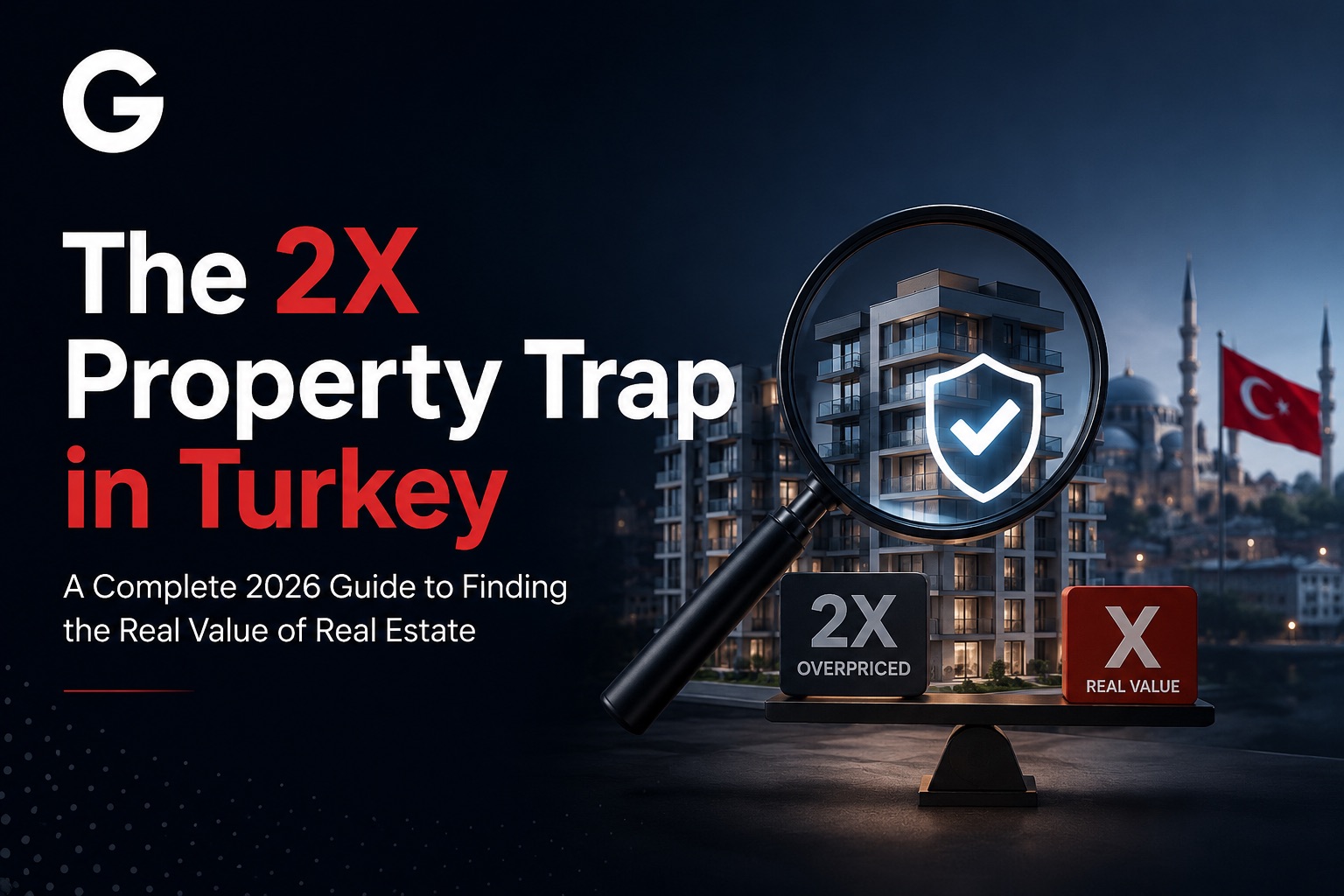
For years, international investors looking at the Turkish real estate market have fallen victim to one of the industry’s most devastating, unspoken realities: The “2X Illusion.” This is a pervasive scenario where foreign buyers unknowingly purchase a property for double its actual local market value—paying “2X” when the real price is simply “X”.
Whether motivated by the promise of high rental yields, a luxury lifestyle in Istanbul or Antalya, or the highly sought-after Turkish Citizenship by Investment program, foreign buyers often step into a market engineered to obscure true property values. In 2026, as the Turkish government tightens regulations and implements digital oversight, surviving this market requires specialized knowledge and vetted local partnerships.
This comprehensive guide will expose how the 2X property trap works, explain the latest 2026 legal regulations designed to protect you, and provide an actionable roadmap to discovering the real price of any Turkish property. Ultimately, securing a profitable asset requires bypassing the noise and connecting with transparent professionals.
The Root of the Problem: Why Do Foreigners Pay 2X?
To solve a problem, you must understand its mechanics. The massive discrepancy between the “tourist price” and the “local price” is not an accident; it is a meticulously crafted business model utilized by opportunistic developers and unregulated intermediaries.
1. The Citizenship Arbitrage ($400,000 Target) The Turkish Citizenship by Investment program requires a minimum real estate purchase of $400,000 USD. Unethical networks exploit this. If a property is locally worth only $200,000 (X), a developer and their associated brokers will artificially inflate the price to $400,000 (2X). They present the buyer with a “packaged deal” where citizenship is guaranteed. The buyer thinks they are making a solid $400K investment, while the sellers quietly pocket a massive 100% markup.
2. The “Guaranteed Return” Illusion Many developers lure investors with promises of “8% to 10% guaranteed rental returns for 3 years.” In reality, there is no economic miracle generating these returns. The developer simply charges you 2X for the property upfront, and slowly refunds your own overpayment back to you disguised as “rental income.” Once the guarantee period expires, the investor is left with a property worth half of what they paid, generating a fraction of the promised rent.
3. The Lack of a Unified MLS (Until Recently) Historically, Turkey lacked a centralized Multiple Listing Service (MLS) equivalent to those in North America. This allowed agents to list the exact same property at vastly different prices depending on the nationality of the buyer. A local Turkish buyer would be quoted 5 Million TL, while a foreign buyer would be quoted $300,000 USD for the same unit.
2026 Regulatory Landscape: How New Rules Protect the Buyer
The Turkish government has recognized the damage the 2X problem causes to foreign direct investment and has implemented aggressive regulatory frameworks leading into 2026. Understanding these rules is your first line of defense.
- Mandatory EİDS (Electronic Listing Verification System): As of the latest rollouts in 2025/2026, real estate listings are strictly regulated. Owners must verify their identity and authorize agencies through the national e-Devlet (e-Government) portal. This system is actively eliminating fake listings, artificial price inflation, and unauthorized brokers from the market. Antalya Law Firm+ 1
- Stricter SPK (CMB) Valuation Reports: For any foreign buyer—especially those seeking citizenship—a valuation report from a Capital Markets Board (SPK) licensed appraiser is mandatory. In 2026, the auditing of these appraisers has become incredibly strict to prevent them from blindly validating the developer’s 2X asking price. The officially appraised value must reflect fair market value, and executing transactions below or above these audited limits triggers severe tax scrutiny. Nexpo Legal
- 100% Tax Penalty for Under-Declaration: Historically, sellers under-declared property values to avoid the 4% title deed (Tapu) tax and heavy capital gains taxes. Under 2026 rules, under-declaring the value results in a penalty equal to 100% of the unpaid tax amount. This forces sellers to be honest about the transaction value, reducing the “shadow pricing” that previously plagued the market. Nexpo Legal
- The 3-Year Holding Rule Enforcement: For citizenship applicants, the property cannot be sold for three years. However, new algorithms track resale values post-citizenship to monitor if severe value drops occur, putting developers under the microscope if their projects consistently lose 50% of their value on the secondary market. www.mfylegal.av.tr
How to Find the “Real Price” (X) of a Home in Turkey
You do not need to fall victim to inflated pricing. By executing the following due diligence steps, you can confidently identify the true market value of any Turkish property before transferring a single dollar.
Step 1: Hire Your Own Independent SPK Appraiser Never use the appraiser recommended by the developer or the selling agent. As an investor, you have the right to hire your own SPK-licensed appraiser (Ekspertiz). Because they work for you, their report will reflect the true, uninflated local market value based on municipal data, construction costs, and localized comparables.
Step 2: Conduct a Micro-Local Comparative Market Analysis (CMA) Do not look at the broader “Istanbul” or “Antalya” averages; real estate is hyper-local. Look at the specific neighborhood (Mahalle). Search local Turkish portals (like Sahibinden or Hepsiemlak) using the Turkish language, rather than English or Russian portals tailored to foreigners. Compare the price per square meter of the target property against older, established resale properties on the exact same street. If the developer is charging a 100% premium over a 5-year-old building next door, you are paying 2X.
Step 3: Analyze the “Resale Exit” Value A property is only worth what someone else is willing to pay for it tomorrow. Ask your broker: “If I needed to liquidate this property next month, what price would a local Turkish buyer pay for it?” If your broker cannot provide a realistic resale assessment or tries to dodge the question, walk away.
Step 4: Audit the “İskan” and Municipal Records A property’s value plummets if it lacks an İskan (Habitation License). A lawyer should check the local municipality (Belediye) and Land Registry (Tapu) to ensure the building is fully legal, has no hidden debts (Haciz), and is registered properly. An un-licensed property is often aggressively marketed to foreigners who do not know better.
Protect Your Capital
Don’t buy into the 2X illusion. Access our verified 2026 framework and bypass the tourist market markups entirely.
View Investment Strategy →The “Tourist Route” vs. The Transparent Broker Route
To visualize the financial impact of the 2X problem, examine how two different investment paths unfold in the Turkish market:
| Feature | The “Tourist Route” (Unvetted Agencies) | The Trust Broker Route (Vetted Partners) |
|---|---|---|
| Sourcing Strategy | High-pressure sales for specific developer projects. | Agnostic search based on true market comparables. |
| Pricing Model | The “2X” Model (Prices inflated to meet citizenship minimums). | The “X” Model (Strict adherence to local market valuations). |
| Valuation Report | Agent uses a “friendly” appraiser to match the inflated asking price. | Investor chooses an independent SPK appraiser. |
| Due Diligence | Rushed process, often hiding missing İskan or legal encumbrances. | Comprehensive legal check of the Tapu, Municipality, and zoning. |
| Exit Strategy | Non-existent. Buyer is trapped with an illiquid asset after 3 years. | Pre-calculated resale strategy built into the initial purchase plan. |
The Solution: Connect with Vetted Trust Brokers
The Turkish real estate market offers incredible opportunities—but only if you approach it as an insider. Beating the 2X trap requires abandoning the flashy, high-pressure tourism agencies and working strictly with B2B-grade professionals who operate on transparency, data, and long-term relationships.
You need partners who understand local valuations, navigate 2026 tax compliances flawlessly, and prioritize your exit strategy before you even buy.
Ready to invest safely and secure the real local price? Do not navigate this market blind. Bypass the tourist markup and build your portfolio with absolute confidence. Discover exactly how we protect our clients and connect directly with our network of strictly vetted, transparent real estate professionals. Explore our secure framework here: https://www.goturkey.estate/turkey-investment-strategy-2026/
Frequently Asked Questions (FAQ) – Turkey Real Estate 2026
Q1: What is the minimum investment for Turkish Citizenship in 2026? To qualify for citizenship by real estate investment, you must purchase property (single or multiple) with an officially appraised and declared value of at least $400,000 USD. The funds must be transferred legally through a Turkish bank, and you will obtain a Foreign Exchange Purchase Certificate (DAB).
Q2: Can I sell the property immediately after getting my citizenship? No. Under the citizenship program, an annotation is placed on your Title Deed (Tapu) prohibiting the sale of the property for exactly three years from the date of acquisition. After the three years, you may sell the property while retaining your citizenship for life.
Q3: What happens if the SPK valuation report comes in lower than the purchase price? If the official appraisal report values the property at $300,000, but the developer is charging you $400,000, your citizenship application will be based on the $300,000 figure, and you will fall short of the threshold. This is the ultimate proof of the “2X problem” and exactly why independent valuations are mandatory.
Q4: Do I have to pay capital gains tax if I sell my property? If you sell the property within 5 years of the acquisition date, you are subject to a progressive capital gains tax on the inflation-adjusted profit (ranging from 15% to 40%). If you hold the property for more than 5 years, the sale is completely exempt from capital gains tax.
Q5: Is it safe to buy off-plan (under construction) properties in Turkey? It carries higher risk. If you buy off-plan, you must ensure the developer has a completion guarantee, bank backing, or government partnerships (like Emlak Konut). You must also have a lawyer review the contract to ensure strict penalty clauses for delivery delays are in place before you sign.
Q6: What are the hidden costs of buying property in Turkey? Beyond the purchase price, budget for the Property Purchase Tax (4% of the declared value, typically paid by the buyer), Value Added Tax (VAT, which can be 1%, 10%, or 20% but has exemptions for first-time foreign buyers in foreign currency), appraisal fees, notary and translation costs, and legal/brokerage fees.